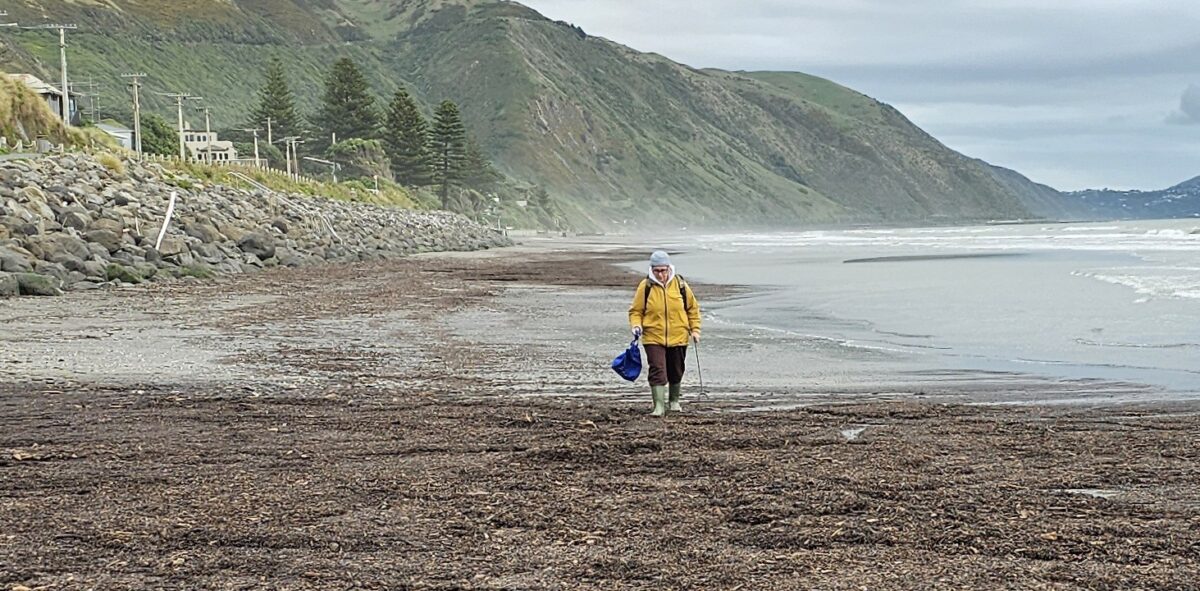
Wandering south along the beach on a cold and misty afternoon, a figure emerged in the distance. Through the sea spray I saw a dark shape with some sort of stick winding its way through the forestry detritus. Could this be an intrepid Te Araroa trailblazer or were the adventures of Odysseus getting to me?
As the figure came closer, I saw it was a person with a large plastic overcoat and gumboots meticulously picking bits of rubbish amongst the wood and pebbles and collecting them in a large cloth bag.
My curiosity and admiration were pricked and after a brief exchange I decided this one-woman warrior was on a mission. She showed no interest in advocating or crusading for her cause and greeted me with a brief gesture. As she disappeared way into the distance along the beach, my curiosity and latent journalistic skills were aroused. Was she from the Council, Greenpeace, the Community Board or part of a campaign that I had failed to register?
Although I am relatively new to Paekākāriki, I knew that someone in the village would know something. Initial inquiries drew a blank with other beach wanderers, and I had already decided she was probably quite private, But, something about her voice and demeanor on our very brief encounter reminded me of someone I knew briefly in a former life. Could this hunch be a further clue that I was embroiled in my own odyssey?
It takes a village to dig out a story and before too long, as part of a casual conversation in a walking group, I discovered one of her family members. Careful consents were negotiated and suddenly I was in the village having coffee with the beach cleanup warrior who was quite happy to tell me about her one-woman mission to get plastic out of the water and off beaches.
Laura Ellis told me she has been doing this work for about twelve months. She showed me a photo of the debris she had collected over the past month or so.
“It’s 99% plastics that come down from rivers. These are from commercial fishing (markers and nets) and private fishing (live hooks and even sinkers.) Then there are plastic bottle tops, straws and a steady stream of shot gun wads, these hold shotgun pellets and exit the gun barrel onto the ground once fired. Farming debris such as hold lines, cow tags and spray cannisters are another source.”
Toothbrushes and hair ties are not uncommon .
Unfortunately, I haven’t come across a $50 note yet!” she rued.
Laura’s mission, it emerged is far more than a clean-up. She walks the length of Paekākāriki beach most days and quietly combs through her weekly haul to recycle or repurpose where possible. This has made her acutely aware of the scale of waste that ends up in our rivers, in the ocean and, eventually, on our beaches.
“90% of what is manufactured is not recycled. There is a lot of degraded polystyrene. These plastics have a devastating effect on marine wildlife and ecosystems. Plastics can persist for many decades continuously degrading to microplastics . These can be ingested by wildlife and later enter the human food chain.”
She continued, “This has made me interested in degrowth economics: focusing on what we have now. It seems like growth beyond reason.”
She refers me to some websites and a recent article in the Guardian that spell out the extent of the problem and some of the issues and solutions that put her work in a global perspective.
Tackling the problem requires governments to reduce the production and consumption of single-use plastics and improve recycling and waste disposal systems. Many of these items are used for only minutes but we need to check if there are replacements or ensure that what we do use makes it to an end-of-life system.
Interestingly, she mentions that compared to some beaches, Paekākāriki beach is relatively clear of obvious debris – chippy packets, drink cans and ice-cream wrappers. It is the plastics and the specific problems they produce that interest Laura.
“Sometimes I just feel so sad for the sea,” she concludes.
She acknowledges that as a former mental health worker, walking the beach is also good for her physical and mental health. She currently works in the health sector but has years of experience as a counsellor working with youth,
Slogans like “Think global, act local” come to my mind. Laura with her quiet, intentional mission is a stunning one-woman warrior. You may see her on the beach, but I suspect she would rather you thought about your use of plastics than acknowledge her.
Editor’s Note: Paekākāriki has a proud tradition of organised and informal beach clean-ups. Among its best-known beachcombers was Hilary Baxter, a daily rubbish collector and daughter of two of Aotearoa’s most famous poets, James K. Baxter and Jacquie Sturm. https://www.xplorepaekakariki.org.nz/hilary-baxter/
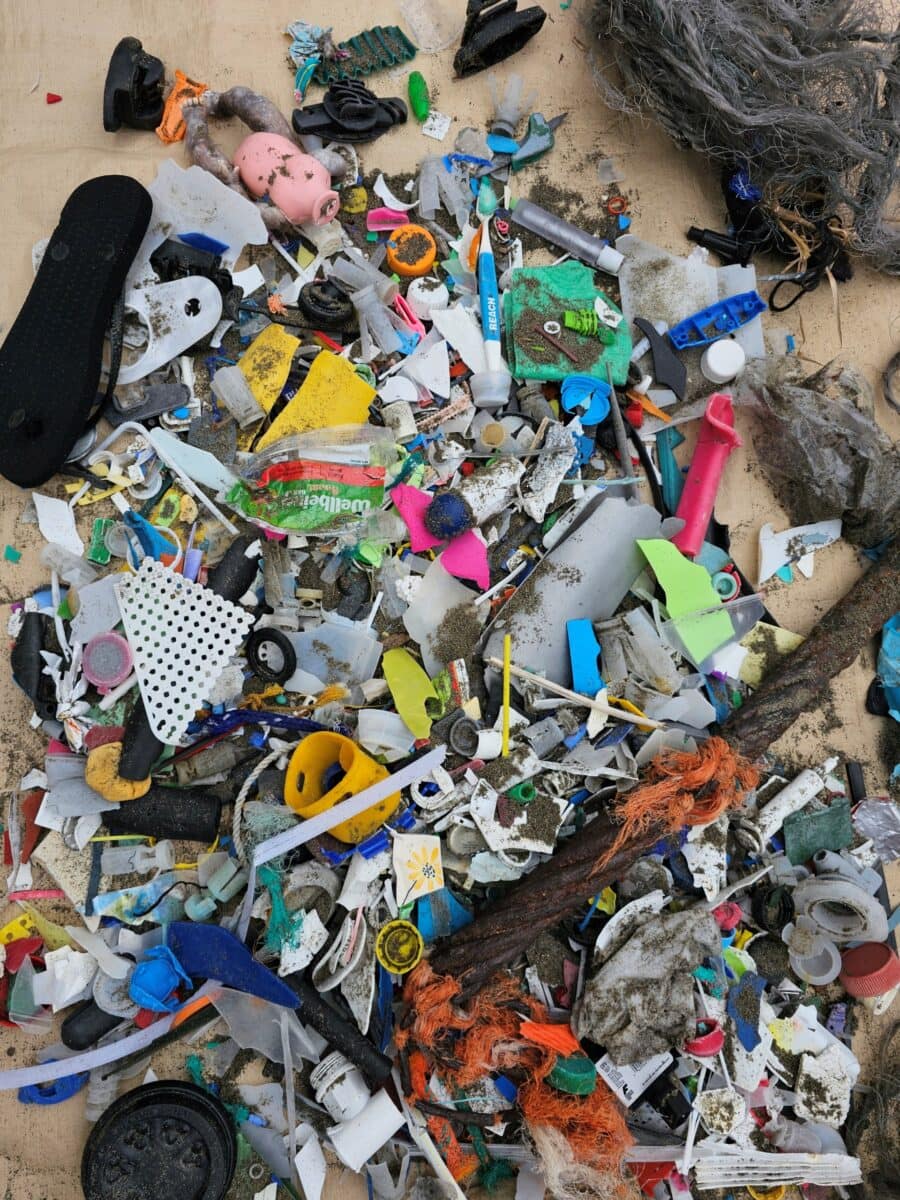
Plastic collected over about 12 trips