May 2001, Ithaca, upstate New York. Not Homer’s Ithaca, the point from which Odysseus began his journey, but the end of our own journey to a new life in the USA. We had left Aotearoa with little sense that, along the way, we would encounter the Cyclops – in the form of al-Qaeda flying planes into the World Trade Centre – and later, descend into the underworld of Ground Zero.
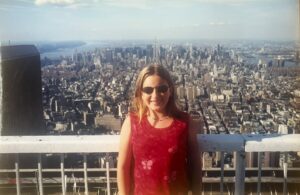
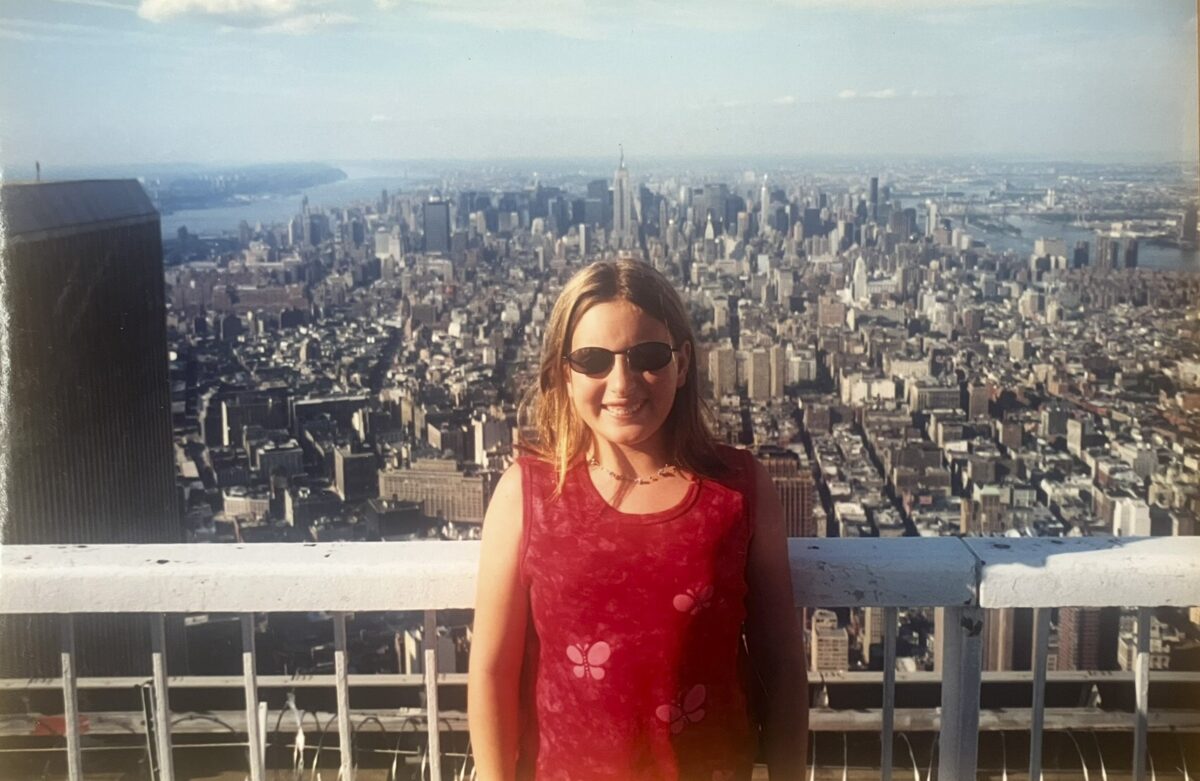
June 2001. Manhattan, NYC. On a weekend break from our new home in upstate New York, we stood on top of the Twin Towers of the World Trade Centre. Within weeks, they would be attacked, burn, and collapse. Timothy McVeigh, the Oklahoma bomber, had just been executed – an event we New Zealanders struggled to understand.
September 11. Ithaca, NY. A mild Tuesday in Fall. Russet oak and maple leaves covered the grass outside our apartment. A plane crossed the busy flight path to Philadelphia leaving white stripes across the cloudless blue sky. My birthday, an unremarkable one, had just passed, but I was looking forward to a party in the international apartment complex where we lived on the outskirts of Cornell University’s rustic campus: our new American home.
The Big Apple was a four-hour bus trip away through the wooded Catskill Mountains. We planned to spend my birthday weekend in Manhattan visiting a diner on Broadway with its usual fries and monster sized breadbasket; seeing ‘The Lion King;’ wandering through Central Park to feed the squirrels and stop at the playground. Its familiar mix of African American, Asian American, white American, and Latino children stood in sharp contrast to the playground demographic back in Paekākāriki.
But on that crisp, clear morning, just four months into our two-year fellowships, I was focused on the upcoming weekly meeting at the institute that had hired me. Even after several weeks in Ithaca, I still struggled to understand my trim, Pilates-toned, super polite, and articulate colleagues. After seeing our daughter off on the iconic yellow school bus, I headed to work around tree lined Beebe Lake hoping to spot the resident beaver slapping its flat, wide tail down on the lake’s surface as it dived, or a common garter or northern water snake slithering away. Dodging muddy patches of the trail, I passed the Albert R. Mann Library: just one of the university’s many well-stocked, wood panelled, specialist libraries.
The staff meeting got underway at 9 a.m. sharp. The professor, celebrated for hauling several million dollars’ worth of funds into Cornell’s coffers, sat at the head of the long mahogany table. In her sixties, slim and glamorous with a big smile and immaculate hair, she was the epitome of charm. She had even enchanted our youngster, resentful at being dragged away from her school and friends in Aotearoa, by taking her to a cafe and buying her a chocolate milkshake but, mostly, by treating her homesickness seriously.
Around the table sat various administrative staff and research fellows, all hanging on the illustrious professor’s every word: “The benefactor of our endowment fund has decided…” Back then, these magic words – “benefactor” and “endowment” – were rarely heard in a New Zealand university. Her updates and instructions softly droned around me as I stared past the manicured lawns to the old stone library in the distance, wondering where to eat lunch. The campus had just under twenty cafés – such were this Ivy League’s eye-watering resources – and I hadn’t tried even half of them. Still, the incongruously named Temple of Zeus, with its rich garlic flavoured tomato soup and buttery rolls and two Tibetan chefs, was hard to beat.
My reverie was broken by the swishing arrival of Cassie, the usually unflappable but morbidly obese secretary with Shirley Temple curls. She sat down heavily. People looked surprised; it was unusual for her to attend the institute’s weekly meeting. On reflection, one of the strangest aspects of that fateful day was her hesitancy to interrupt the meeting with her earth-shattering news. At last, the professor asked, “Is everything ok, Cassie?”
Her unforgettable reply: “I’m sorry to inform you but a plane has flown into the World Trade Centre and one of the Twin Towers is burning.”
The professor scrutinised her secretary for several seconds: “Are you quite sure?”
“I wish I wasn’t!”
“Well, I guess we won’t believe it until we see it with our own eyes. Meeting adjourned as of now.”
En masse, we hurried to a room with an enormous TV screen. The North Tower was burning. But it was the replay of the second plane striking the South Tower that was so chilling. My first thought was: America is at war and we are here. New Zealand had never seemed so distant or so precious.
It was 9.35 a.m., less than an hour after the first impact at 8.46 a.m. (Flight 11 from Boston) and just over half an hour after the second strike at 9.03 a.m. (Flight 175, also from Boston). Then, came news that another flight had hit the Pentagon (Flight 77 from Dulles outside Washington, DC) – while yet another (Flight 93 from Newark, New Jersey) was still somewhere overhead. Shortly after 10 a.m. it crashed into an empty field in Pennsylvania. We watched as the North Tower collapsed at 10.28 a.m.
Our daughter! Before cell phones and without a car, we were out of contact but confident that her school would look after her. When she finally returned home with her friends on the yellow bus, we were relieved to be reunited – and with Chippy, the striped back chipmunk that had taken up lodgings under the fridge. Later, she told us that when her teacher announced what had happened, the fifth graders stood together, hands on hearts and recited The Pledge of Allegiance. To our Antipodean offspring, this overt patriotism was foreign and frightening.
Messages began to flood in from far-flung friends and family. In New Zealand, the attacks had happened in the small hours of Wednesday morning. The first message came from our reclusive neighbour in Paekākāriki. ‘Are you guys ok?’ he emailed from his seaside cottage sometime around 2 a.m. His Hutch might have been small and rough, but he was deeply tuned into international affairs – an insomniac who often followed the BBC through the night.
The next morning after a fitful sleep, I walked to nearby Collegetown and bought a New York Times, devouring it over a coffee and bagel. A few pages in there was the heart stopping photograph of a man falling headlong to certain death from the upper floors of the burning north tower. For millions of people across the world, this image came to symbolise, the horror of that day: the unimaginable ‘choice’ of being incinerated or of jumping from the 106th or 107th floor to escape smoke and fires.
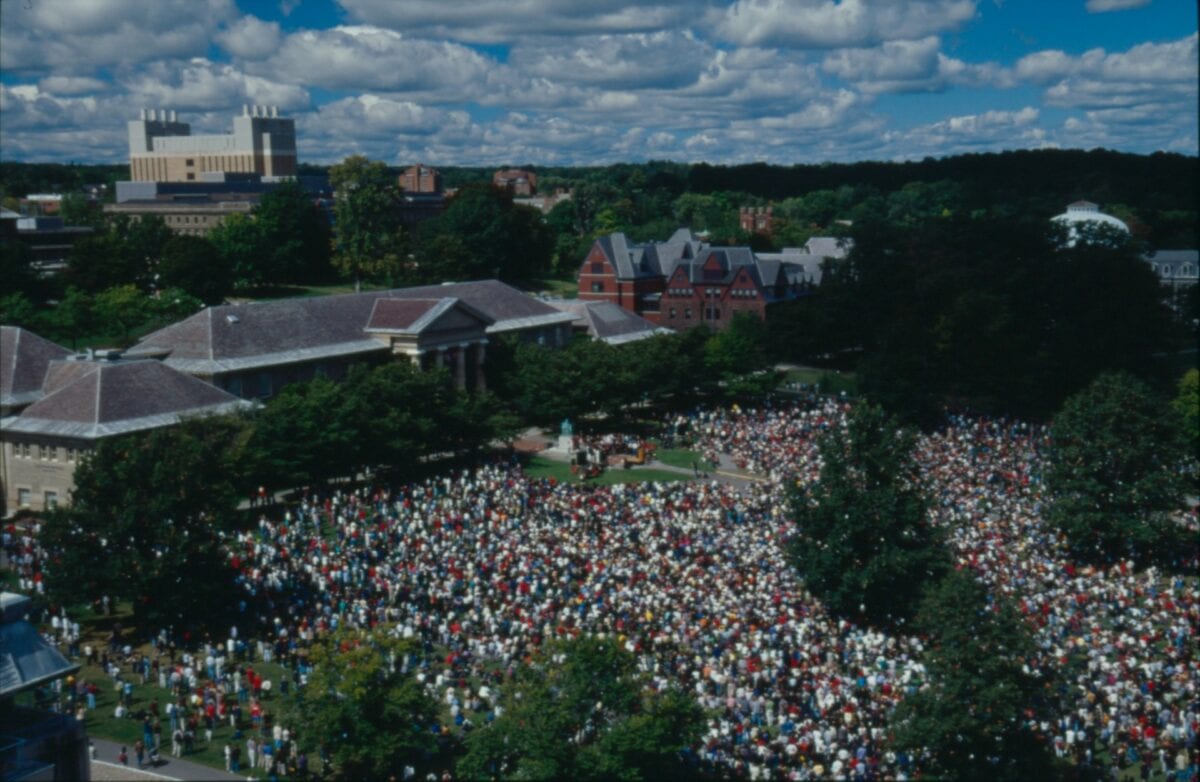
The next evening, we attended a candlelit vigil to the dead and injured on Cornell’s campus and a few days later, found ourselves among a throng of 1200 staff and students gathered in the Arts Quad. The atmosphere at both events was eerie and sombre. Reports trickled in from colleagues who were related to, or friends of, a victim.
The skies had fallen strangely silent. US airspace had closed the previous day at 9.45 a.m. Meanwhile, swamping the media were the previously unfamiliar names of Osama Bin Laden, identified as mastermind of the attacks, and al-Qaeda, the Islamic terrorist group that he founded. Soon after after the attacks, while US airspace was still closed, members of the Bin Laden family living in the United States were flown back to Saudi Arabia beyond the reach of an understandably vengeful, retaliatory America.
Then came the anthrax scares. Packets of white powder began arriving by post on campus, and to avoid possible contamination, we found ourselves being shuffled between various buildings. The alerts were later found to be hoaxes. Soon after, true to the logic of late capitalism, the disaster merch appeared; everywhere we turned the Stars and Stripes decorated cars, houses, caps, and clothing.
Closer to home, the upending of life was evident in the changed culture of the apartments’ communal laundry. Once a bustling and predominantly female zone, it effectively emptied out. Many women who previously congregated among the washing machines and dryers were from Middle Eastern countries, stranded and isolated for much of the day while their husbands were involved in research or study. Here, hijabs in a variety of colours, some worn with jeans and some with traditional dress, were once on display. Before September 11, any loneliness was dispelled by a visit to the washhouse.
“Where do you come from?”
“What is your husband studying / researching?”
“What a beautiful baby!”
“How old are your children?”
Often, several languages were spoken simultaneously. I was embarrassed by their polite switch to English when I or another ‘American’ entered, wanting to say, “Don’t stop talking in your own language.” Other times, I envied their laughing, linked-arm sisterhood; the intense and precarious camaraderie of the powerless. Fatima from Afghanistan, whose husband had a long beard and a severe presence, and Zeyneb from Azerbaijan, a pretty, sole mother who had a young daughter with waist length plaits, had become, for a brief time, my friends.
In the attacks’ aftermath, these women vanished like bright-headed birds scattered by the wind. As Islamophobia, surveillance, and discrimination intensified, the hijab became an obvious target for harassment. Reports spread of women having their headwear torn off in the street. Fatima disappeared without a message, without a word. I understood. A miasma of fear covered everything. The women left before their husbands who usually held the scholarships. For a while, the men in their shirts and jeans were less visible.
“You are either with us or against us” proclaimed US President George W. Bush in early November.
But where did that leave us? In 2003, we opposed the invasion of Iraq. Now, with the war on Iran, do we no longer stand shoulder to shoulder with America?
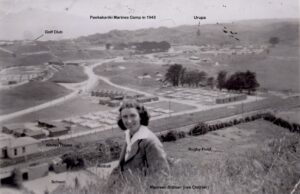
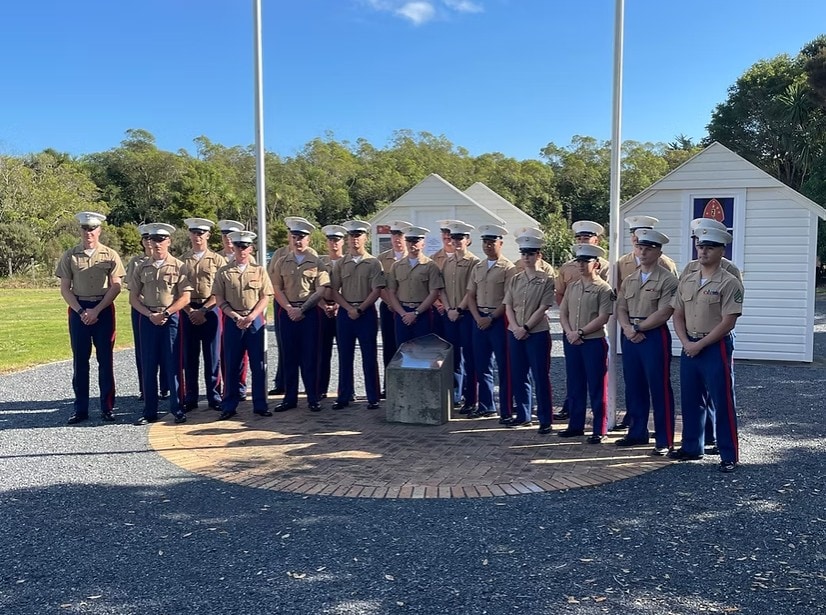
For Paekākāriki, and for New Zealand more broadly, such a question might once have seemed almost treasonous. Between 1942 and 1944, thousands of US Marines came here to defend against the threat of Japanese invasion. Paekākāriki became the site of a major camp, with more than 15,000 Marines stationed in the village at any one time. Many later died on Tarawa, an island still remembered here in the name of one of our streets.
Source: The New Zealand American Association, https://www.nzaa.org.nz/copy-of-marines-kapiti
Paekākāriki Museum holds a collection of Marines’ memorabilia and photographs. Near the Paekākāriki entrance to Queen Elizabeth Park there is a Marines’ commemoration and, further north, at Mackays Crossing a Camp Paekākāriki memorial and reconstructed hut mark the site’s wartime history.
Paekākāriki.nz features stories on the village’s distinctive Second World War history and the tragedy of Tarawa. These include Mark Te One’s ‘Marine’ https://paekakariki.nz/marine/ and Dani Deluka’s ‘Haere mai, Amerikana’ https://paekakariki.nz/haere-mai-amerikana/2/.
Raw footage from a video ‘US Marines in New Zealand’ made by Steve La Hood, U.S. Marines Trustee, filmmaker, and Paekākāriki resident, is also available. https://marinesnz.com/collections/norm-hatch-collection/videos